Toulouse is the “Pink City.” There you go. That settles it.
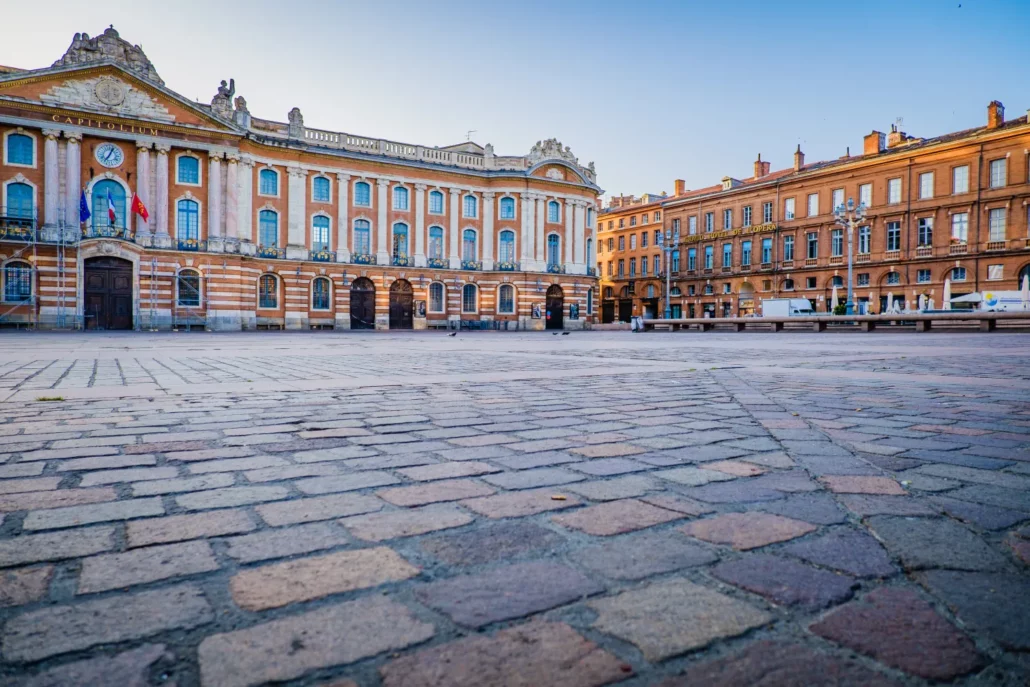
All you have to do is open any travel guide, look at the Capitol’s facade on a sunny day, or listen to someone describe Toulouse for more than thirty seconds. The city is pink because it’s built with pink bricks.
That makes sense.
Except that’s not the case.
Or, to be more precise: yes, but not really.
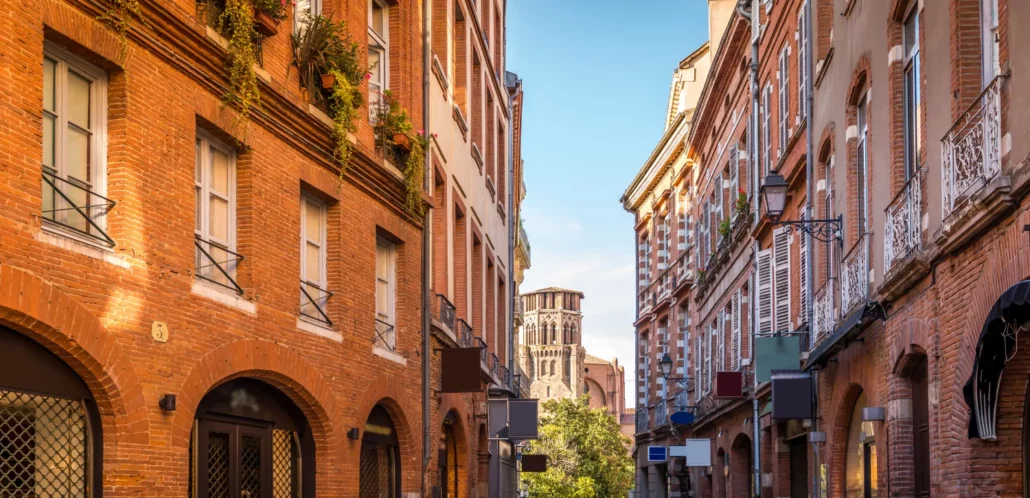
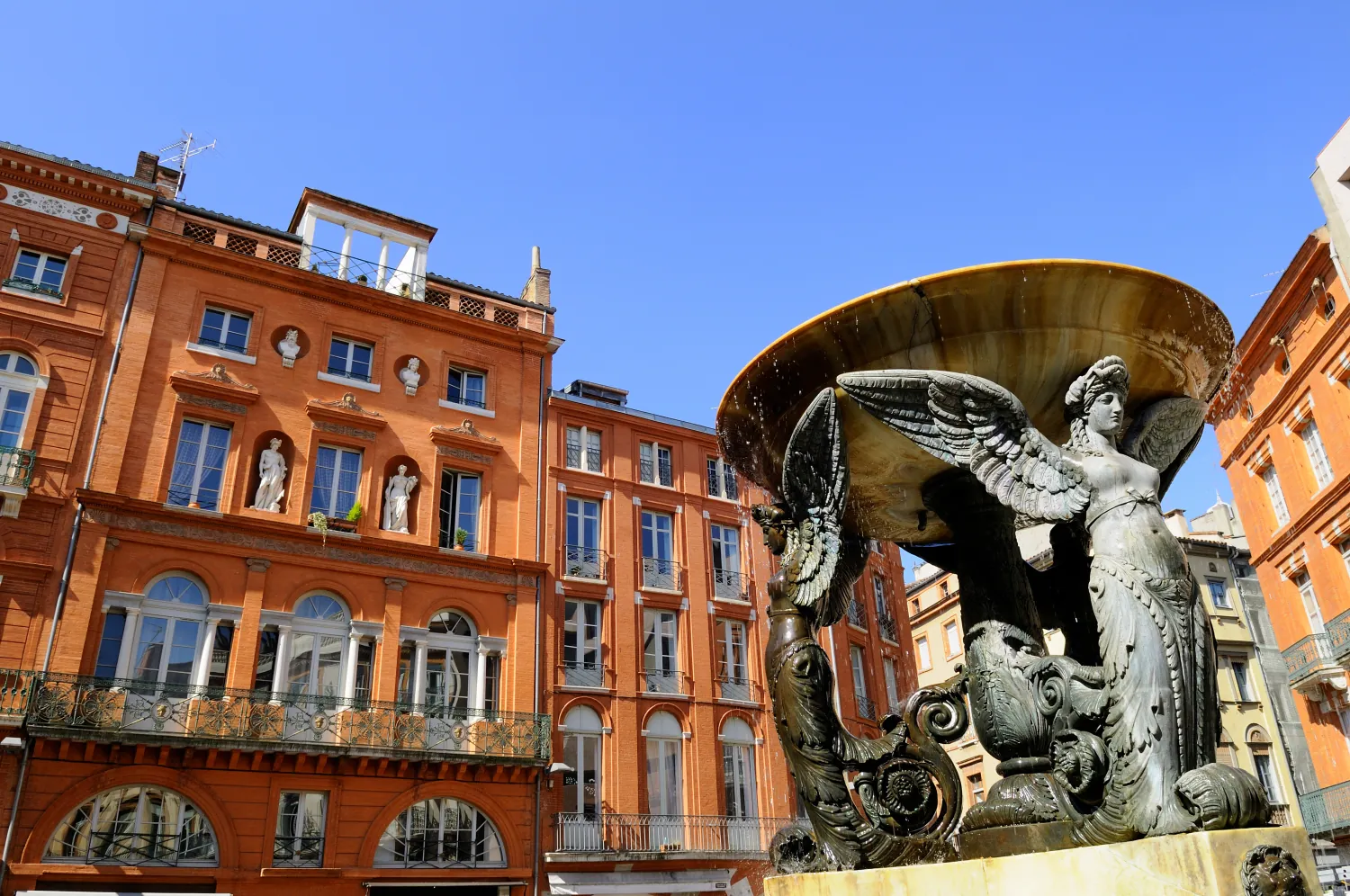
Because the bricks in Toulouse aren’t particularly pink. Some are red. Others are orange, brown, salmon-colored, almost yellow, or downright dark. For several centuries, some Toulouse residents even went to great lengths to hide them.
As for the nickname “Ville rose,” it first appeared nearly two thousand years after the first major terracotta buildings were constructed in Toulouse.
In other words, seriously answering a seemingly trivial question like “Why is Toulouse nicknamed the Pink City? ” requires bringing in geologists, archaeologists, chemists, art historians, a few regional poets, and, finally, the forerunners of the tourist office.
All that for a color. So welcome to Toulouse, the “Pink City”—but it’s actually a tiny bit more complicated than that…
Before pink, there was mud
To understand the walls of Toulouse, you have to go back a few tens of millions of years before the Capitole was built. That’s slightly less convenient when planning a weekend trip, but much more effective for understanding the local architecture.
The subsoil beneath Toulouse consists largely of a vast molasse formation—deposits resulting from the erosion of the surrounding terrain. INRAP, the National Institute for Preventive Archaeological Research ( ), identifies in the Toulouse region formations consisting mainly of clays and sands, accumulated since the Oligocene (about 34 million years ago), to which have been added alluvial terraces shaped by the Garonne River and its tributaries.
To put it simply: Toulouse isn’t built on a massive, ready-to-use stone quarry.
It does, however, have clay. Lots of clay.
It is often said that the people of Toulouse chose brick “because there was no stone.” That’s a bit of an oversimplification. Archaeologists have shown that ancient builders were perfectly capable of bringing limestone, sandstone, and marble from the Pyrenees, particularly via the Garonne River. However, given that clay is an ideal building material, the idea of costly river transport has often been dismissed—and has been since Roman times.
The Romans were already building Toulouse with bricks
And they certainly didn’t hold back.
In a study published in 1997 in the academic journal Pallas, archaeologists Raphaël de Filippo and Christian Rico point out that the landscape of ancient Toulouse was distinguished by the unusual prominence of brick in both public and private buildings.
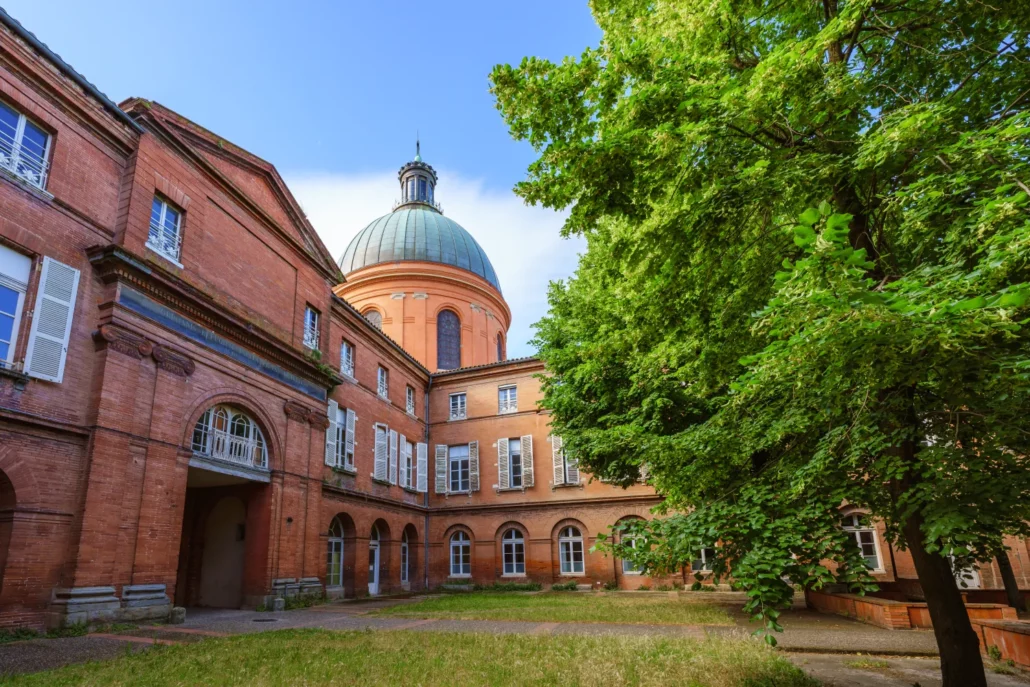
The fanum discovered in Vieille-Toulouse, dating from the second half of the 1st century BCE, is believed to be the oldest known brick building in Gaul. The city walls of the new Roman city, its theater, and later the Purpan amphitheater also made extensive use of terracotta, a remarkable feature of Gallo-Roman architecture.
So the “Pink City” actually existed long before it had a press secretary.
And this Toulouse brick has a distinctive feature that stands out immediately when you place one next to a classic modern brick.
It’s huge.
A brick weighing nearly eleven kilograms
The famous Toulouse fairground brick has gradually settled on a size of approximately 42 × 28 × 5 centimeters. By comparison, the traditional brick from northern France measures around 22 × 10.5 × 5.5 cm—almost half the size.
Toulouse-style masonry was also designed for masons with very strong lower backs, and a standard brick of this size from that era can weigh around 11 kg.
Technically, this large surface area combined with a thin wall makes fairground bricks relatively fragile. Broken bricks were therefore reused as filler material, while the best pieces were reserved for visible applications.
Even more interesting: not all of them came out of the oven the same color.
And here, we need to set art history aside for a moment and turn to chemistry.
Why does a brick turn red?
Clay naturally contains various minerals. Among them are iron compounds.
When fired in the presence of oxygen, iron can formhematite, whose chemical formula is Fe₂O₃. It is this mineral that contributes significantly to the red hues of terracotta. Incidentally, the same type of phenomenon is responsible for Mars’s characteristic color.
Research in materials science shows that the final color depends on the clay’s mineralogical composition, the temperature reached, and the atmosphere inside the kiln; thus, a change in firing conditions significantly affects the chemical reactions and alters the brick’s appearance.
In a less oxidizing atmosphere, some of the iron oxides can transform into darker phases, such as magnetite. Increase certain temperatures, alter the carbonates or the proportion of iron, and the color changes again.
In short, a brick has never been told to “turn pink.” It’s not a choice, a plan, or an artistic intention—it’s chemistry.
The old Toulouse kilns introduced another variable: their temperature was not perfectly uniform. Some bricks heated up more than their neighbors. The result was a wide range of colors, from light shades to very dark reds. The most thoroughly fired bricks could be used in areas requiring greater strength, while others were reserved for protected elevations or facades.
Toulouse’s famous “pink uniformity” is therefore, chemically speaking, a rather rough approximation that, incidentally, doesn’t hold up to close visual inspection when you stroll through the streets in and around our hotel in downtown Toulouse.
Toulouse even tried to stop being red
The story certainly doesn’t end with those initial chemical conditions. A region rich in clay, an ancient tradition, iron-rich bricks, a few centuries—and voilà, a reddish-orange city that the light transforms into a postcard: that’s a bit of an oversimplification.
In any case, the former Toulouse residents felt that the narrative needed to be taken further, because what is appealing today was also the subject of criticism in the past.
Starting in the 18th century and especially in the 19th, exposed brick was not always considered a noble material. Facades were frequently covered with plaster or lime wash in shades of white, yellow, or ochre. Heritage documents from the Ministry of Culture demonstrate just how deeply this practice is rooted in traditional Toulouse architecture.
Then came the major urban transformations of the 19th century. Paris emerged as the model of urban aesthetics to be emulated.
And since Paris has light-colored stone facades, Toulouse decides, with admirable confidence, that it, too, would like to look as if it were built with a material that it has, in fact, never used much.
During the urban expansion of the 1870s, some buildings in Toulouse used light-colored or yellow bricks intended to imitate cut stone. The Municipal Archives show that the imitation went beyond just color: the facades featured the rustication and masonry patterns characteristic of stone.
In short, Toulouse boasts an extraordinarily original brick architecture and spent part of the 19th century trying to make people believe it was limestone. Toulouse is still trying to find its identity…
And that is precisely where the “Pink City” comes into view
In fact, the name “Ville Rose” does not date back to the mists of time. The nickname is not a legacy of some whimsical medieval oral tradition. Nor is it Roman in origin. It is not even particularly old.
Research by Luce Barlangue, an art historian and former member of the FRAMESPA laboratory at the CNRS and the University of Toulouse Jean-Jaurès, places its origins at the very end of the 19th century. Until then, guidebooks had tended to describe Toulouse as a “ Palladian city, ” in reference to its intellectual and artistic tradition.
Between the 1890s and 1900s, however, a regionalist literary circle began to develop a different portrayal of the city.
Here, the color pink is less a technical reference to the chemical composition of the bricks than a poetic color. Toulouse is feminized, associated with figures such as Clémence Isaure or La Belle Paule. The color pink evokes southern charm, gentleness, and light.
And then there’s a reason that’s almost scandalously simple.
"Tolose" rhymes with "rose"
Two millennia of terracotta architecture, thirty-four million years of regional geology, and a few redox reactions have thus also found practical application.
Tourism Seals the Deal
From that point on, poetry encounters something terribly modern: place branding.
In 1903, one of the first tourist information offices was established in Toulouse. Its challenge was already a familiar one: travelers passed through Toulouse before continuing on to the Pyrenees.
So we need to make them want to stay.
In 1904, geographer S. Guénot proposed highlighting not only the city’s monuments, but also its atmosphere, its light, its climate, and its brick architecture. A few years later, the phrase “Ville rose” appeared on the covers of the tourist office’s newsletter. The postcards from the Labouche company also helped spread this image.
The nickname is just right for sticking in people’s minds, and much more appealing and understandable to a traveler than “Palladian city,” which does require a bit of explanation before coffee.
In the 1910s, the guidebook *Three Days in Toulouse: The Pink City* effectively established the phrase. The brand was born.
A small problem: not everyone likes pink
In the 1920s and 1930s, however, some intellectuals in Toulouse began to find the color downright dull.
The Writer Armand Praviel takes particular aim at this Toulouse that is “as pink as a melt-in-your-mouth candy.” For him, Toulouse must be red—red like its brick, its history, its medieval violence, and its southern temperament. In 1933, he even published *La Ville rouge, Toulouse, Capital of Languedoc*.
A century later, Toulouse Métropole’s communications department has clearly won the game.
Red City: 0.
The Pink City: probably a few million postcards.
The city has finally lived up to its nickname
In a final twist of irony, when “Ville rose” began to gain prominence in the early 20th century, Toulouse was still largely covered in plaster and whitewash.
It was not until the 20th century that heritage restoration gradually brought exposed brick back into the spotlight. Preservation guidelines evolved, particularly in the 1940s, and the removal of certain types of plaster then became a guiding principle in heritage restoration.
In other words, Toulouse has, to some extent, come to be the city that its own nickname had created.
The concept of tourism predated the landscape that we now regard as ancient and unchanging.
So, in the end, is Toulouse really pink?
Because the children keep repeating that it’s not pink—it’s orange, ochre, red, rust, crayfish, pumpkin, and roge. Yes, the city is pink. Provided that you do not verify the results with a spectrophotometer.
It is made of bricks whose colors depend on the clay, iron, firing process, time, restorations, and light. Some facades are red in the morning, orange at noon, and almost purple as the sun sets.
So the “Pink City” isn’t actually a specific color. It’s an idea that the imagination, nature, and a few clever marketers have brought to life.
An idea born of geology, crafted by brickmakers, forgotten beneath layers of limestone, rediscovered by a few poets, transformed into a tourist attraction, and ultimately becoming the visual identity of an entire city.
The next time you come to explore Toulouse, perhaps the most fun thing to do will be to look at its walls and try to spot the pink. Explore Toulouse from the Hôtel d’Orsay. You’ll mostly see red, orange, ochre, and brown.
And somewhere amid all these colors, there’s a city that has managed, for over a century, to convince everyone that it’s pink. Honestly, at this point, it’s not just architecture—it’s culture!